Automation Testing Interview Questions for All Experience Levels
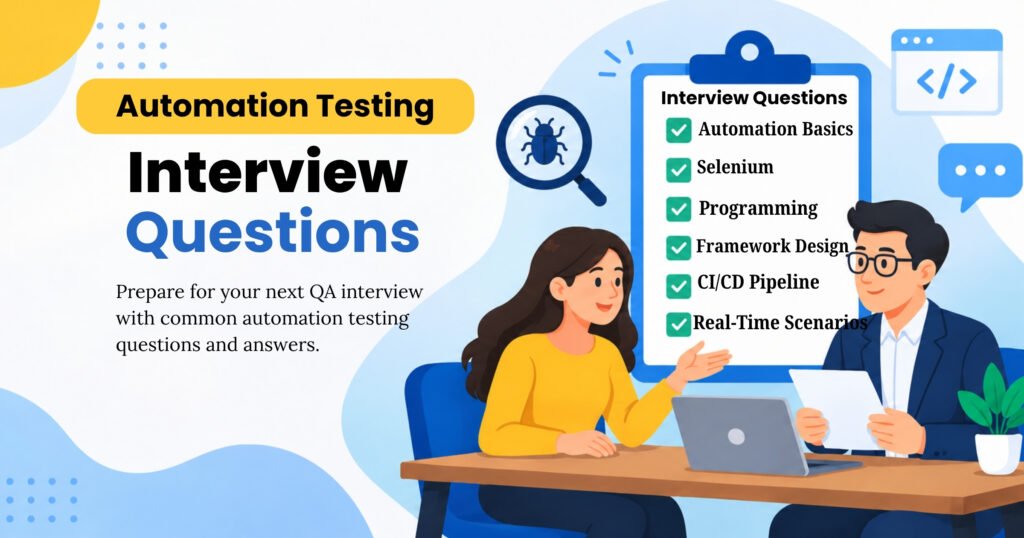
This guide contains 80 Automation Testing interview questions, divided into four experience levels: Freshers, 1–3 years, 3–6 years, and 6–12 years. It covers automation fundamentals, Selenium, Playwright, programming, frameworks, API testing, CI/CD, debugging, and real-time project scenarios.
1. Automation Testing Interview Questions for Freshers (0 Experience)
What is automation testing, and why is it used?
What is the difference between manual testing and automation testing?
What are the advantages and limitations of automation testing?
Which test cases should be automated, and which should remain manual?
What is Selenium WebDriver?
What is Playwright, and how is it different from Selenium?
What are the different components of the Selenium suite?
What is a locator in automation testing? Explain different types of locators.
What is the difference between XPath and CSS selectors?
What is the difference between absolute XPath and relative XPath?
What is the difference between
findElement()andfindElements()in Selenium?What are implicit waits, explicit waits, and fluent waits?
What is the difference between
getText()andgetAttribute()?How do you handle dropdowns, checkboxes, and radio buttons?
How do you handle alerts, frames, and multiple browser windows?
What is an assertion, and why is it important in automation?
What is the Page Object Model (POM)?
What is a test framework? Explain TestNG, JUnit, and pytest.
What is the difference between verification and validation in automated tests?
How would you automate a basic login test from opening the browser to validating a successful login?
2. Automation Testing Interview Questions for 1–3 Years of Experience
How do you identify and write reliable locators for dynamic web elements?
How do you handle
StaleElementReferenceExceptionin Selenium?How do you handle
NoSuchElementExceptionandTimeoutException?What is the difference between hard assertions and soft assertions?
How do you implement waits for elements that load dynamically?
How do you handle dynamic tables and verify specific row values?
How do you automate file upload and file download scenarios?
How do you handle multiple tabs and browser windows in Selenium or Playwright?
What is data-driven testing, and how do you implement it?
How do you run test cases using TestNG or pytest?
What are test fixtures and setup/teardown methods?
How do you use the Page Object Model to avoid duplicate code?
How do you capture screenshots when a test fails?
How do you generate and analyze automation test reports?
How do you automate test cases across different browsers?
How do you handle test data stored in Excel, CSV, or JSON files?
How do you debug a test that passes locally but fails in the CI environment?
How do you execute tests in parallel, and what problems can occur?
How do you integrate an automation suite with Jenkins or another CI/CD tool?
Describe an automation testing project you worked on, including the tools, framework, your responsibilities, and the challenges you faced.
3. Automation Testing Interview Questions for 3–6 Years of Experience
How would you design an automation framework from scratch?
What is the difference between a modular, data-driven, keyword-driven, and hybrid framework?
How do you organize test scripts, page objects, utilities, test data, and configuration files?
How do you implement reusable methods without making the framework difficult to maintain?
How do you manage environment-specific configurations such as URLs, credentials, and browser settings?
How do you handle authentication and session reuse in an automation framework?
How do you identify and reduce flaky tests?
How do you decide whether a failed test is caused by an application defect, a test script defect, or an environment issue?
How do you implement retry logic without hiding genuine application defects?
How do you design parallel execution for a large regression suite?
How do you prevent shared test data from causing failures during parallel execution?
How do you automate REST API testing and validate response status codes, headers, and bodies?
How do you validate API response data against database records?
How do you handle dependent API requests and dynamically generated IDs or tokens?
How do you implement logging, screenshots, traces, and other debugging evidence?
How do you integrate automated tests into a CI/CD pipeline with separate smoke and regression stages?
How do you select test cases for automation based on risk, frequency, stability, and business value?
How do you measure automation effectiveness beyond the total number of automated test cases?
How do you manage framework changes when application locators or workflows frequently change?
Describe a major automation issue you solved. How did you identify the root cause, implement the fix, and prevent recurrence?
4. Automation Testing Interview Questions for 6–12 Years of Experience
How would you define an automation strategy for a large enterprise application?
How do you decide which tests belong at the unit, API, integration, and UI levels?
How would you design a scalable automation framework for multiple teams and applications?
How do you evaluate whether to use Selenium, Playwright, or another automation tool?
How would you migrate a large legacy automation framework to a modern technology stack?
How do you establish coding standards and framework governance across multiple teams?
How do you design automation architecture for microservices and distributed applications?
How would you make a large regression suite reliable and fast enough for continuous delivery?
How do you identify bottlenecks in a pipeline where automation execution takes several hours?
How do you manage test isolation, test data, and dependencies across parallel pipelines?
How do you handle authentication, secrets, test accounts, and access control securely?
How do you determine whether an automation failure should block a release?
What automation and quality metrics do you report to senior management, and how do you interpret them?
How do you calculate automation ROI and justify investment in framework development?
How would you address a high rate of flaky tests across multiple projects?
How do you integrate UI, API, database, accessibility, and performance checks into an overall quality strategy?
How do you review automation code and ensure maintainability, reliability, and test independence?
How do you mentor automation engineers and assess the technical maturity of the team?
How would you create a continuous improvement plan for a team with low automation coverage and frequent production defects?
Describe a major automation architecture or strategy decision you made. What alternatives did you evaluate, and what business and technical outcomes followed?
30 Real-Time Automation Testing Interview Scenario Questions
These questions are based on practical situations faced by automation testers working with Selenium, Playwright, Java, Python, API testing, and CI/CD pipelines. They are suitable for freshers, 1–3 years, 3–6 years, and 6–12 years of experience.
1. UI Automation and Selenium / Playwright Scenarios
1. Dynamic Web Element: Your automation script cannot find a button because its ID changes every time the page loads. How would you identify a stable locator and automate the button?
2. Intermittent Test Failure: A login test passes five times and fails on the sixth attempt without any code changes. How would you investigate the failure?
3. Element Not Clickable: Selenium throws ElementClickInterceptedException when clicking the Submit button. How would you identify the cause and resolve it?
4. Stale Element: Your script finds a web element, but the page refreshes part of its content before the click. Selenium throws StaleElementReferenceException. How would you handle this?
5. Synchronization Issue: An application takes several seconds to load data from an API, but your script attempts to validate the data immediately. How would you synchronize the test without using fixed sleeps?
6. Multiple Browser Tabs: Clicking a link opens a new browser tab, but your script continues checking the original page. How would you switch to the new tab and verify its content?
7. I Frame Handling: A payment form is displayed inside an iframe, and your automation cannot locate the card-number field. How would you automate this form?
8. Dynamic Web Table: A table contains 100 customer records across multiple pages. How would you find a particular customer, validate their details, and handle pagination?
9. File Upload and Download: Your application allows uploading PDF files and downloading generated reports. How would you automate both operations and verify the downloaded file?
10. Cross-Browser Failure: A checkout test passes in Chrome but fails in Firefox. How would you determine whether the problem is caused by the application, the browser, or the automation script?
2. Test Framework and Coding Scenarios
11. Duplicate Code: Your automation project contains similar login steps in 50 test cases. How would you refactor the code to make it reusable and maintainable?
12. Test Data Management: Your team needs to test login with 100 combinations of valid and invalid credentials. How would you design data-driven testing using Java or Python?
13. Parallel Execution: Tests pass when executed individually but fail when run in parallel because multiple tests update the same user record. How would you fix the problem?
14. Unstable Regression Suite: Your regression suite contains 500 tests, but around 20 tests fail randomly on every run. How would you identify and reduce flaky tests?
15. Failed Test Evidence: A test fails in the CI pipeline, but it passes when you rerun it locally. What screenshots, logs, traces, and environment information would you collect to investigate it?
3. API and Database Automation Scenarios
16. API Returns Incorrect Data: An API returns HTTP 200 OK, but the response contains an incorrect customer address. How would you detect and report the defect?
17. Authentication Failure: Your API test works with a valid access token but fails after the token expires. How would you automate token generation, refresh, and expiry validation?
18. Dependent API Requests: You must create a customer, create an order for that customer, and then cancel the order. How would you automate the workflow when each API response provides an ID required by the next request?
19. UI and API Mismatch: An API returns the correct product price, but the website displays a different price. How would you isolate the source of the defect?
20. Database Validation: An API reports that an order was created successfully, but the corresponding database record is missing. How would you validate the issue without creating unreliable tests?
4. CI/CD and Framework Maintenance Scenarios
21. Local Success, CI Failure: Your automation suite passes on your computer but fails in Jenkins or another CI pipeline. What would you check first, and how would you troubleshoot it systematically?
22. Slow Automation Execution: Your regression suite takes four hours to complete, delaying every release. How would you reduce execution time without sacrificing important coverage?
23. Browser Version Update: A browser update causes several automation tests to fail. How would you identify compatibility issues and maintain a stable test environment?
24. Failed Test Retries: Your framework retries every failed test three times, and the final report shows most tests as passed. Why can this be dangerous, and how would you improve the reporting strategy?
25. Test Environment Unavailable: The QA environment becomes unavailable halfway through regression execution. How would you distinguish infrastructure failures from application defects and handle the release decision?
5. Advanced Real-Time Automation Scenarios
26. One-Time Password (OTP): Your application requires an OTP during login. How would you automate OTP testing securely without depending on a real user’s phone for every test?
27. Duplicate Payment: Your payment automation clicks the Pay button twice because the application response is slow. How would you test idempotency and verify that the customer is charged only once?
28. Asynchronous Processing: An order is submitted successfully, but its status changes from Pending to Completed after a background job runs. How would you automate the test without using arbitrary long delays?
29. Production Defect Missed by Automation: A major production defect escaped even though the regression suite passed. How would you investigate the gap and improve the test strategy?
30. Release Readiness: Your automation suite passes 95% of tests, but the remaining 5% includes failures in payment processing and account login. Would you recommend releasing the application? Explain how you would assess the risks.